

Industries
Trucking & Carriers
For bulk trucking and logistics companies hauling and storing material for customers. Your customers judge you on two things: did it arrive, and can you prove it. Rebulk turns both into a record you and your customer read the same way, and turns visibility into something you sell, not something you apologize for.
The Challenge
The load is delivered. The proof is in four places.
A trip produces a pickup weight, a delivery weight, a signed BOL, and a customer expectation about what should have arrived. When those four don't line up, the invoice sits.
Chasing that down means calls to the terminal, a scan of a ticket, and a spreadsheet built to answer one question for one customer.
Rebulk keeps the delivery, the weights, and the documents on one record the customer can see, so the answer is already assembled before anyone asks.
The Workflow
From pickup to a paid invoice
Step 1
Load against the terminal record
When the pickup is at a Rebulk terminal, the railcar, commodity, customer, and weight the load came from are already recorded. Nothing gets rekeyed onto the trip.
Step 2
Deliver against the BOL
What was picked up and what was delivered land on the same record, with the paperwork attached to both ends of the move.
Step 3
Measure what's on the customer's ground
For material you store or replenish, the balance is a measured quantity, not a running tally. Both sides read the same number.
Step 4
Invoice with the evidence attached
The delivery record, the weights, and the documents are already assembled when the invoice goes out, so disputes settle in minutes.
Still writing BOLs by hand? Create clean, printable bills of lading in minutes with the free BOL generator.
What carriers get out of it
Faster payment on the freight you already haul, and a stronger pitch for the freight you want.
Proof of delivery customers accept
Every delivery is verified against the BOL and tied to a record the customer can see: what was picked up, what was delivered, and the paperwork behind both. When the invoice goes out, the evidence is already attached.
Fewer quantity disputes
Most disputes start because the carrier's number and the customer's number come from different places. When both sides look at the same measured record, the argument usually never starts, and when it does, it settles in minutes, not weeks of held invoices.
Visibility as a service you sell
Give customers a live view of their material: what's in storage, what's in transit, what was delivered this week. That's a line in your next bid that most carriers can't match, and a reason existing customers don't shop the lane.
Terminal operations, if you run them
Carriers that operate transload or storage sites get the full terminal system: railcars, BOLs, scale tickets, demurrage, and customer reporting on the same record as the trucking side.
The Platform
What carriers run on today
Carriers work with us today through Rebulk Transload, on the terminals you run or pull from, and Rebulk Inventory, for the material you deliver and store.
Product UI
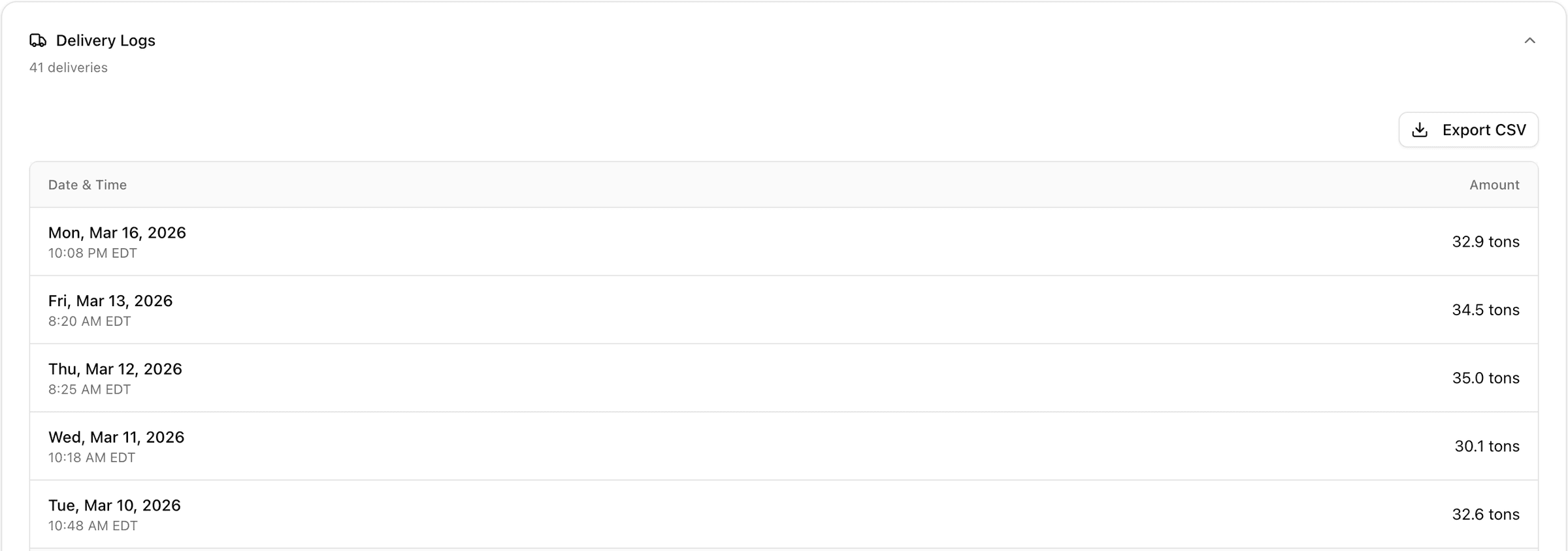
The delivery record your customer can read
Every delivery, timestamped, with the quantity that actually landed. Exportable, so the answer to a billing question is a file, not a phone call.

Carriers run on Rebulk today
“Rebulk gives us hours back every single week. What used to take phone calls and stacks of paper now takes seconds.”
Josh Mathews, Director of Rail and Supply Chain, Usher Transport
Usher Transport, a family-owned tank truck carrier since 1946, runs its rail and transload operation on Rebulk: railcars, transfers, documents, and billing on one record.
Prove every delivery
Tell us what you haul and store, and for whom. We'll show you what a delivery record customers accept looks like, along with a customer portal worth putting in your next bid. Both get set up around your lanes, your sites, and your customers.