

Cut the time railcars sit at your facility.
Cars don't sit because the crew is slow. They sit because nobody sees dwell accumulating: arrival, spot, and release times scattered across a railroad notification, a whiteboard, and a spreadsheet that nobody trusts.
Why it happens
Dwell is one of the few costs in a terminal that grows while nobody is watching it.
Dwell is a month-end calculation, not a live number
By the time someone adds up days per car, the days are already spent. Nothing warned the team while the clock was still running.
Arrival, spot, and release times live in three places
The railroad's notification, the crew's whiteboard, and an office spreadsheet. None of them agree, and none of them is a record you'd bill or dispute from.
The expensive car is the quiet one
Crews work the cars in front of them and the cars customers call about. The car quietly running past its free time is the one nobody is looking at.
Demurrage arrives as an invoice, not a warning
The first anyone hears of a charge is when it's already billed, and disputing it means rebuilding dates from memory and paper. Storage and demurrage rates only move one direction.
Not sure what dwell is costing you? Estimate per-car charges against your free time and daily rates with the free rail demurrage calculator.
How Rebulk solves it
Make dwell visible while it accrues, and give the team a running order that puts the costly cars first.
Know the car is coming before it's on your track
Railcar visibility from release to placement across the network, so crews, tracks, and unloading capacity get planned around cars that are actually arriving.
A clock on every car from the moment it arrives
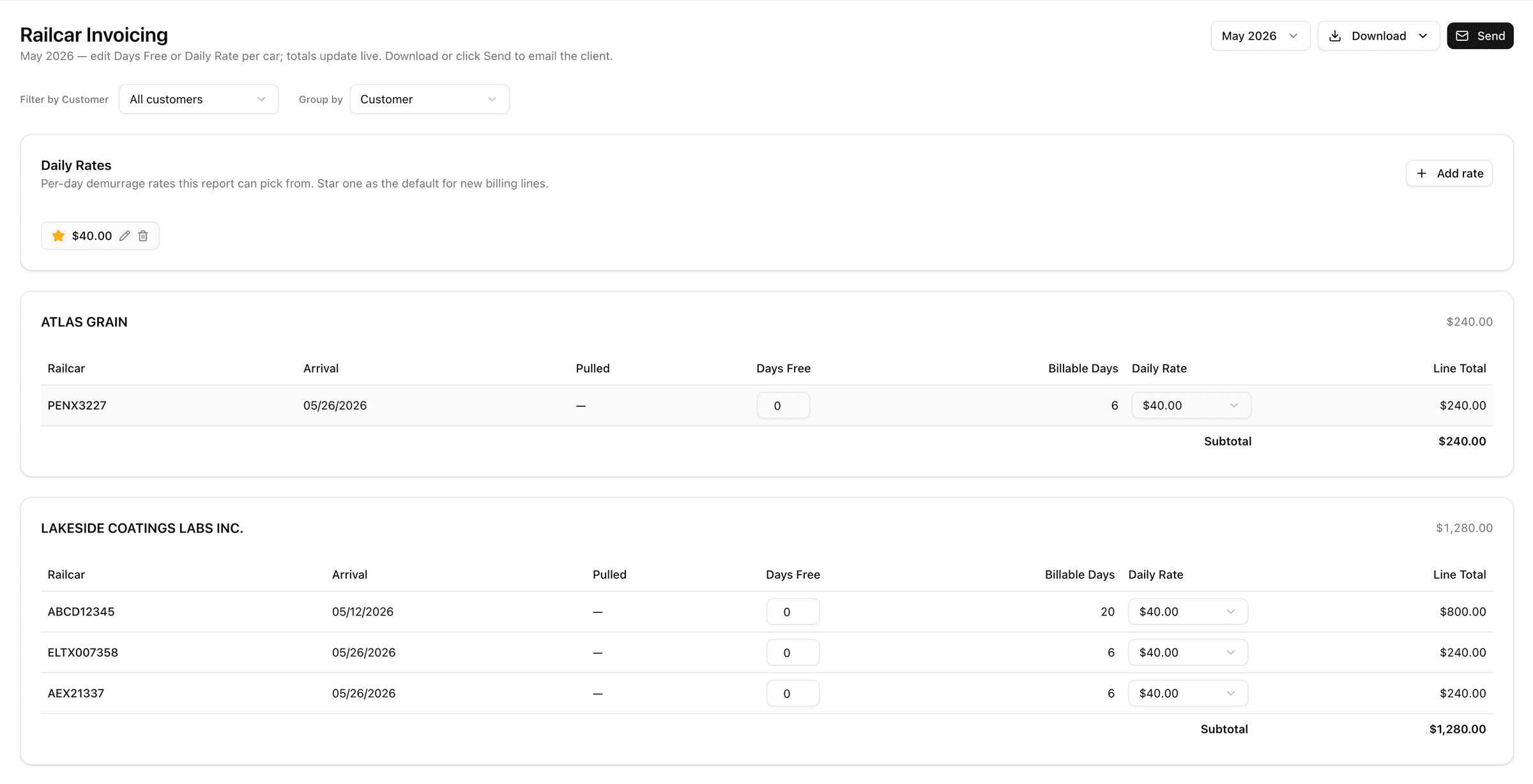
Dwell is tracked per car from arrival, and storage days accrue on their own. The number is on the screen while there's still time to do something about it.
Work the oldest cars first
Sort the yard by dwell, customer, or commodity and see which cars to unload and release next, instead of whichever one came up on the radio.
Release decisions with the record behind them
Arrival, status, and release dates are timestamped per car. When you bill a customer for storage, or a railroad bills you, the evidence is already attached.
Products involved
Rebulk Track & Trace and Rebulk Transload are live today and carry the dwell work: visibility inbound, per-car clocks and release records on site. Rebulk Yard Switching is in early access and adds placement and switch sequencing on top.
The dwell clock, end to end
Every timestamp that decides a demurrage charge, captured where it actually happens.
- 1
Released by the shipper
The car appears on your radar as soon as it starts moving toward you.
Rebulk Track & Trace
- 2
Inbound and visible
Crews and unloading capacity are planned against cars that are actually coming, not a guess.
Rebulk Track & Trace
- 3
Arrival logged, clock starts
Dwell begins accruing per car the moment it's on your track, with the arrival date on the record.
Rebulk Transload
- 4
Placed and worked in order
Cars are spotted and sequenced so the oldest and most expensive get handled first.
Rebulk Yard Switching · Early Access
- 5
Unloaded and released
The release date is recorded, storage days close out, and the documentation stays with the car.
Rebulk Transload
Proof
Usher Transport can see which cars are still waiting
Before Rebulk, finding a car's status at Usher's rail and transload operation meant radio calls and a walk out to the track, and questions like “which cars have been unloaded, and which are still waiting?” depended on who you could reach.
Today the team has a live view of every car in the yard from any device, with every move, hold, and release recorded against the car.
Read the Usher Transport story“Rebulk gives us hours back every single week. What used to take phone calls and stacks of paper now takes seconds.”
Find the cars that are sitting
Tell us how a car gets from the railroad's notification to your release today, and where the days disappear. We'll show you the same trip on one record, with the clock visible the whole way.
Need the whole terminal moving faster? Increase terminal throughput.