

Industries
Bulk Shippers & Receivers
For manufacturers, feed mills, food and ag processors, energy producers, and any operation that ships or receives bulk materials. Rebulk replaces the estimate in your inventory column with a measured number, so purchasing, finance, and operations all work from what's actually on the ground.
The Challenge
The number in the system is an estimate of a physical pile
Material comes in by rail and truck, goes into a shed, a bunker, or a pad, and comes out by loader. What the system says is on hand is receipts minus consumption, corrected once or twice a year by a physical count.
Between those counts, shrink hides, short loads get paid, and reorder decisions come from a walk-out estimate plus a safety margin.
Rebulk measures the pile instead, and keeps the measured number next to the book number where purchasing, finance, and operations can all see the gap.
The Workflow
From inbound car to reorder decision
Step 1
See the inbound before it lands
Railcars are visible from release to placement, so next week's plan is built on where cars actually are, not on a status email from three days ago.
Step 2
Verify what arrived
Received tons are tied to the BOL and the invoice. A short load or a paperwork error surfaces as a flagged discrepancy the day it happens.
Step 3
Measure what's on the ground
Fixed sensors, drone flights, or a smartphone scan, whichever fits each site. Your team works with the numbers, not the equipment.
Step 4
Reorder on days of cover
Measured inventory and consumption become days of cover per material, per site. Reorder early enough to avoid an emergency truck, late enough to avoid tying up cash.
How much is actually in that pile? Get tonnage from pile dimensions and material density with the free stockpile volume calculator.
Three numbers that stop being guesses
What's on hand, what actually arrived, and when you run out. Most operations estimate all three. Rebulk measures them.
Shrink management
Know your real inventory
Your book inventory says one thing. The ground says another. Rebulk keeps a measured number next to the book number, so the gap between them is visible every week instead of surfacing once a year. When shrink starts, whether it's moisture loss, spillage, a miscalibrated scale, or theft, you catch it while it's still a small number, not after the audit does.
Delivery verification
Verify every delivery
Confirm what actually arrived against what was billed. Rebulk ties received tons to the BOL and the invoice, so a short load or a paperwork error shows up as a flagged discrepancy the day it happens. You stop paying for material you didn't receive, and you have the record to back up the claim.
Run-out projections
See run-out coming
Rebulk turns measured inventory and consumption into days of cover for every material at every site. Instead of a walk-out estimate and a safety margin, you reorder on data: early enough to avoid an emergency truck, late enough to avoid tying up cash in a full shed.
Yard & port management
Run your yards and ports
Material rarely sits in one place: it moves through plant yards, port laydowns, and dock storage on its way in or out. Rebulk manages your material across all of them: measured piles by location, railcars spotted in your yard, vessels and trucks loading against real numbers, and one record that follows the material from gate to gate.
And if material moves by rail: see every inbound car from release to placement, so the plan for next week is built on where cars actually are, not on a status email from three days ago.
Product UI
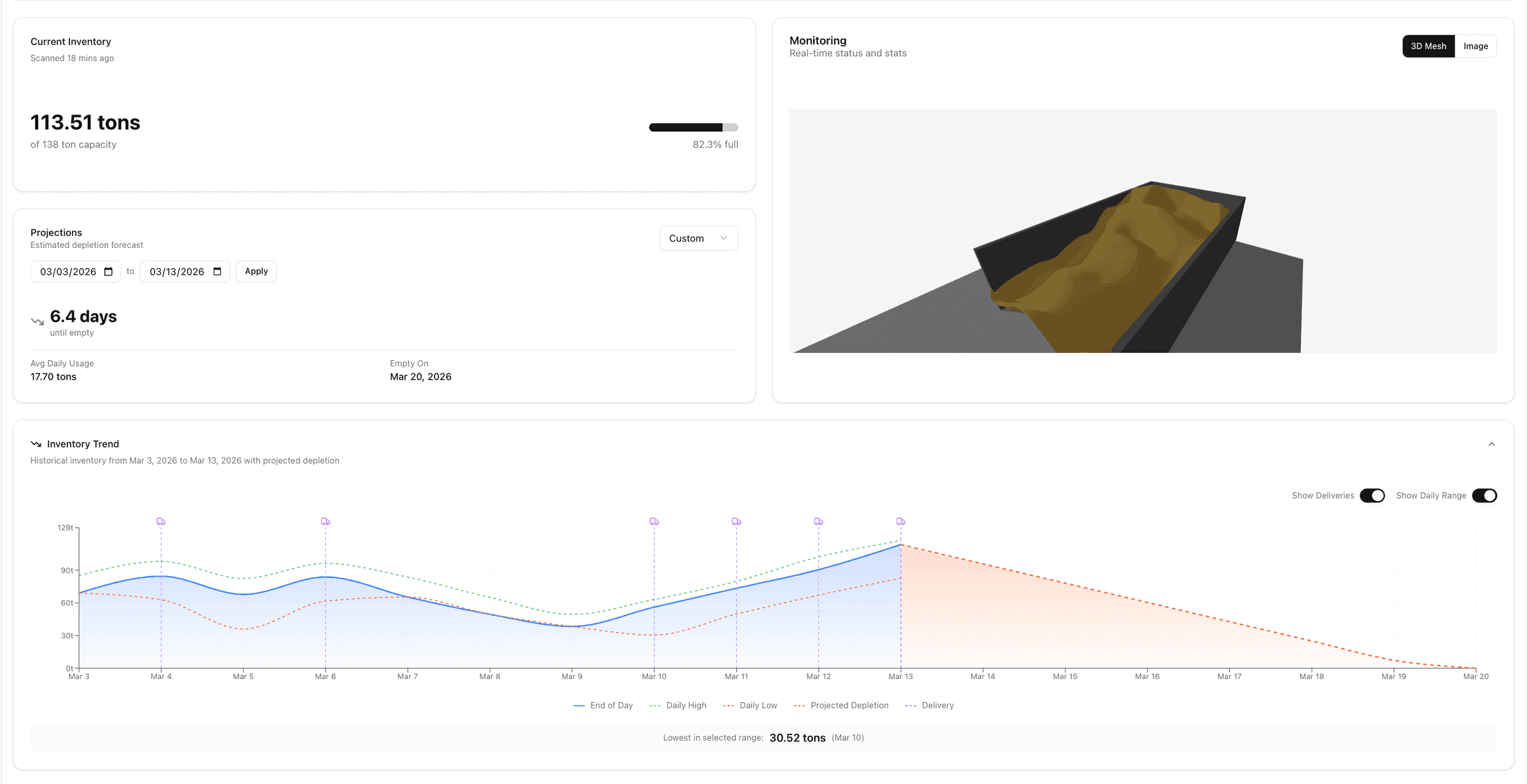
Days of cover, per material, per site
Measured inventory and consumption plotted forward, so the reorder conversation starts from a projection instead of a walk-out estimate.
The Platform
Track & Trace and Rebulk Inventory lead here
Start with the one that solves today's problem. They share one record, so each one you add makes the others better.
Under the hood, the measured record comes from fixed 3D sensors, drone flights, or a smartphone scan, whichever fits each site. Your team works with the numbers, not the equipment.
Customer Proof
A large U.S. feed provider runs its ingredient inventory on Rebulk
They use Rebulk for visibility into ingredient inventory, depletion trends, shrink, and delivery activity across dairy customer sites: planning earlier, with fewer logistics fire drills.
Read the feed provider storyWhere this runs today
See how shippers and receivers use Rebulk in your industry.
Put a measured number in your inventory column
Tell us what you ship or receive and where it sits. We'll show you what shrink, verification, and days of cover look like in your operation, configured for your sites, your materials, and your reporting.