
Industries
Transloaders
For terminals moving bulk between rail and truck. Spreadsheets and whiteboards can't hand off cleanly to billing: untracked tons, missed demurrage, hours on status calls. Rebulk puts the whole operation on one clear, trackable process, the source of truth from operations to billing.
The Challenge
The terminal knows what happened. The office finds out later.
A car arrives, gets spotted, gets unloaded, and a truck hauls it out. That sequence produces a waybill, a placement time, a scale ticket, a storage day, and an outbound BOL, and in most terminals each of those lands somewhere different.
By month-end, someone rebuilds the story from email, PDFs, and memory. Tons go unbilled, demurrage goes uncollected, and “where's my car?” takes a phone call.
Rebulk records the work once, as it happens, and lets billing and customer reporting read from it. No two terminals run alike, so we set it up around yours: your tracks, your commodities, your billing terms.
The Workflow
How a car moves through Rebulk
The same four steps your crew already works, captured once instead of re-entered four times.
Step 1
Inbound paperwork files itself
Waybills and BOLs land on the right railcar on their own. Car numbers, products, weights, and customers are read off the document instead of typed in.
Step 2
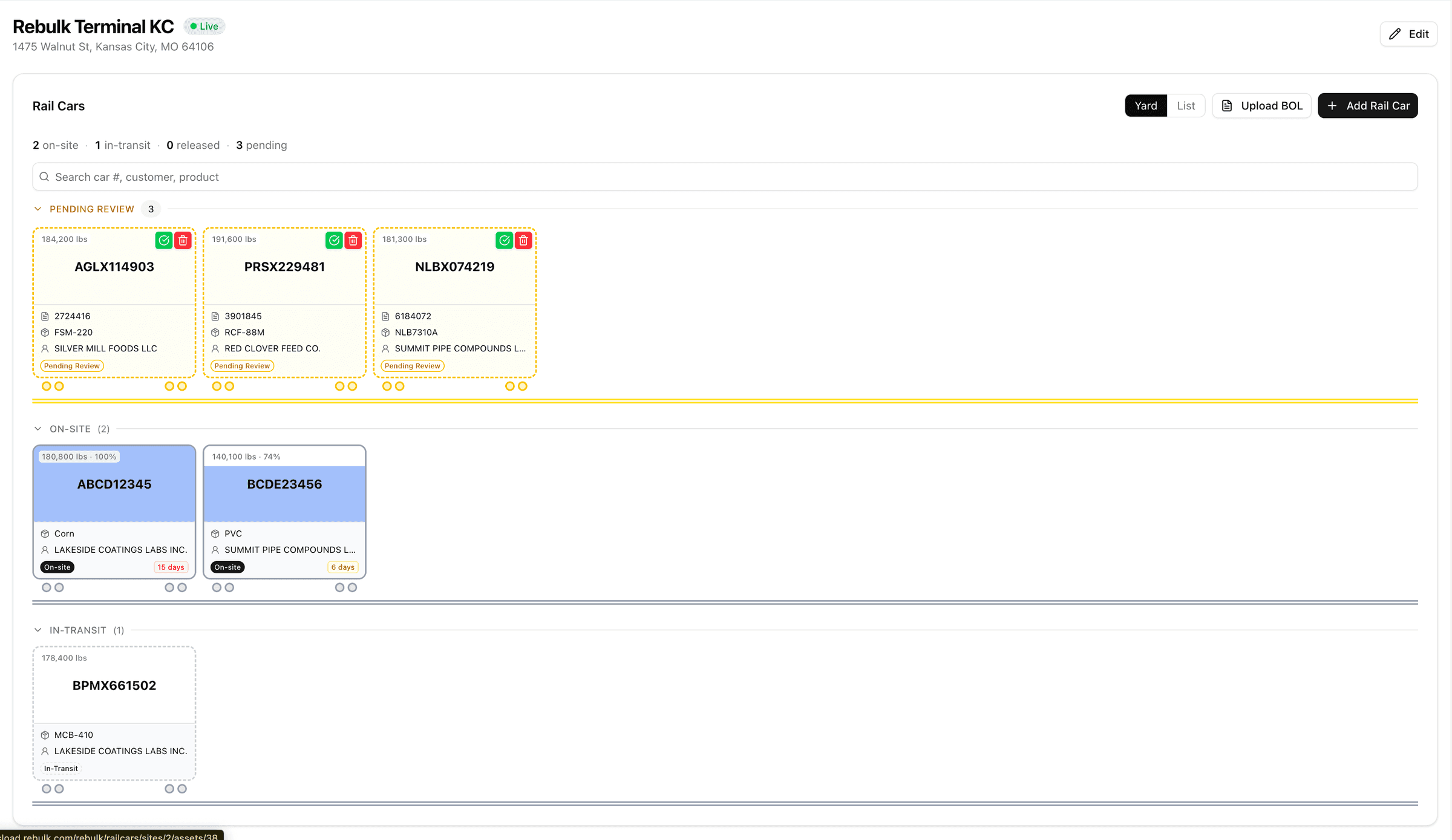
The car goes on the yard picture
Track, spot, customer, commodity, and status are live from placement, and the dwell clock starts the moment the car arrives.
Step 3
Transfers and scale tickets attach
Every truck load in or out records against the railcar, the customer, and the inventory it came from. Weights ride along with it.
Step 4
Billing comes off the record
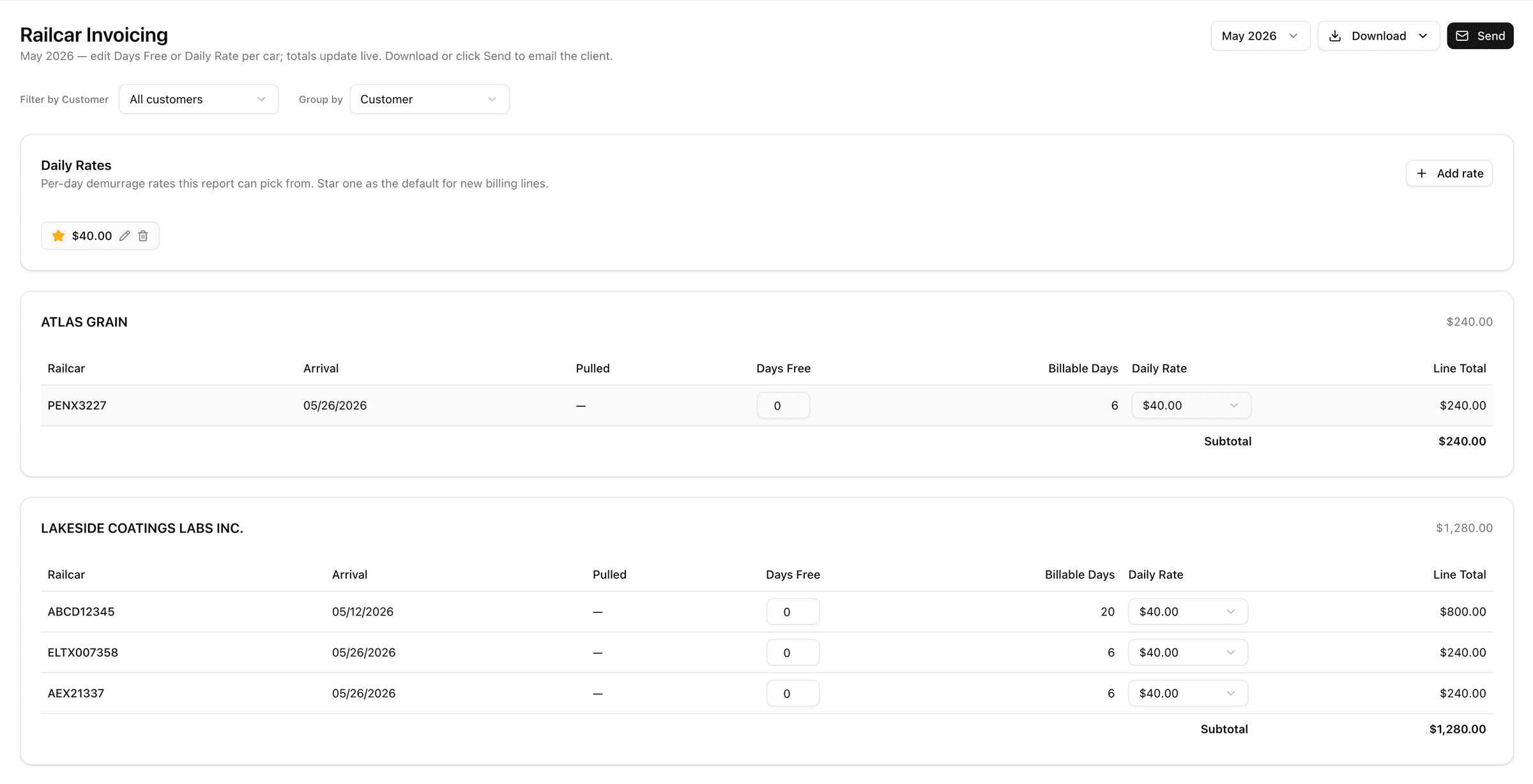
Storage days, demurrage, outbound BOLs, and customer reports are already line items by the time you invoice. Month-end is review and send.
What is dwell costing your terminal? Estimate per-car demurrage against your free time and daily rates with the free rail demurrage calculator.
What changes when the terminal runs on one record
Every car, ton, transfer, and document lands on the record as it happens, so billing, demurrage, and customer reporting run off work that's already tracked.
A clear process from work to billing
Every BOL and scale ticket lands against the right shipment, the right customer, and the right railcar. Nothing moves through the terminal without a record, so billing works from clean, complete data and end-of-month invoicing takes hours instead of days.
Demurrage tracked per car, automatically
The clock on every car runs automatically from placement. When a customer's car sits, you have the dates, the free-time terms, and the record to bill it confidently, and when a railroad bills you, you have the evidence to dispute the charges that aren't yours.
Answer customers without a phone call
"Where's my car?" and "how much is on the ground?" stop being interruptions. Customers see their own inventory, car status, and documents in a portal, and scheduled reports go out without anyone building a spreadsheet. Your best people go back to running the terminal.
Measured inventory by customer and commodity
What you're storing for each customer is a measured quantity, not a running tally that drifts between physical counts. When a customer questions their balance, both of you look at the same number, and storage billing rests on ground truth.
The Platform
Rebulk Transload leads. The rest connects to it.
Start with the terminal operating system. Add yard planning, railcar visibility, and measured inventory as your operation grows into them. Every product reads and writes the same record.
Rebulk terminals are also listed in the transload facility directory, where shippers looking for capacity can find you.
Product UI
See the terminal. Not another spreadsheet.

Proven at a working terminal
“Before Rebulk, we were spending too much time chasing information and then manually inputting it. Now we can see what is happening across the operation much faster.”
Frank Venezia, Director of Operations, Venezia Transport
Venezia Transport runs bulk transload operations on Rebulk: railcars, paperwork, and customer reporting on one system instead of a patchwork of spreadsheets.
Read the Venezia StoryRun your terminal on one system
Walk us through how a car moves through your terminal today. We'll show you the clear, trackable record Rebulk builds from that work and how it carries straight through to billing, then set it up to match how you already run: your materials, your billing terms, your customers' reports.