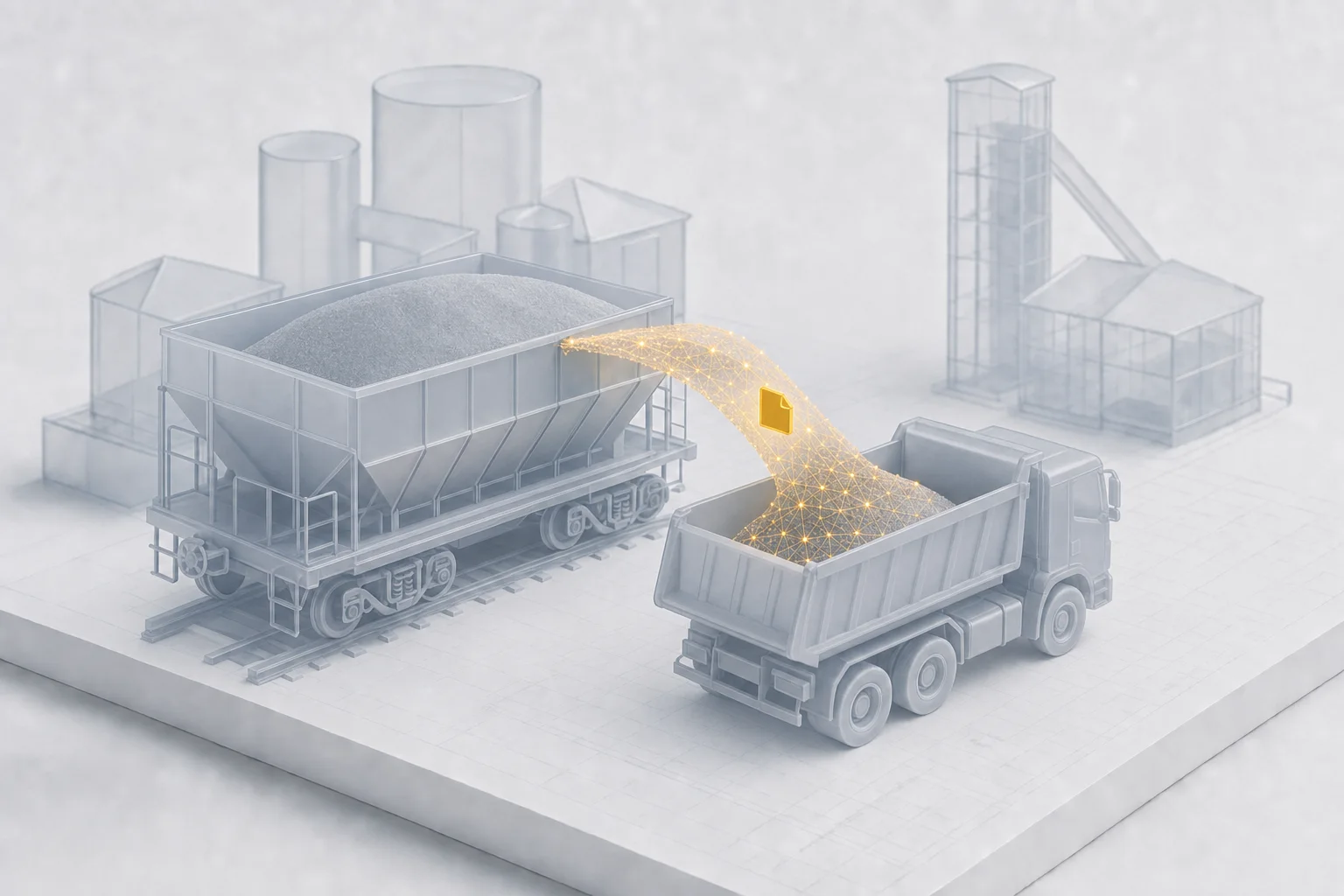
The short answer: Transloading is transferring freight from one mode of transport to another, most often rail to truck or truck to rail, at a terminal built for the handoff. It is how bulk commodities reach customers who are not on a rail line. The move itself is simple. The inventory and billing around it, spanning many owners, products, and documents, is where transload gets hard.
The one-line definition
Transloading is the transfer of goods from one transportation mode to another partway through a shipment. A railcar of fertilizer arrives at a terminal, the product is unloaded, and it leaves by truck for the last stretch to a farm or plant. The reverse happens too: product arrives by truck, gets consolidated, and departs by rail. The terminal in the middle, the transload facility, exists to make that handoff fast, measured, and documented.
Transloading matters because rail is the cheapest way to move heavy freight over long distances, but very few end users sit on a rail spur. Transload bridges that gap: long-haul economics on the rail leg, truck flexibility for the final miles.
What moves through a transload terminal
Transload terminals handle some of the highest-tonnage freight in the economy. The commodities that move loose and heavy, the ones measured by the ton rather than counted by the box, are exactly the ones that transload:
- Grain, feed ingredients, and other agricultural bulk
- Aggregates, sand, and frac sand
- Fertilizer, cement, and industrial minerals
- Plastics and resins
- Biomass, wood chips, and forestry residue
- Steel, pipe, and project cargo on the break-bulk side
A single terminal often runs several of these at once, for several different customers, on the same tracks and the same yard. That mix is the root of the complexity that follows.
How transloading works, step by step
- Inbound. A railcar or truck arrives with product, a bill of lading, and a waybill naming the customer, the commodity, and the weight.
- Unload and transfer. The product moves out of the inbound car into storage or straight into the outbound truck: pneumatic transfer for dry bulk, conveyors for aggregate, pumps for liquids.
- Stage or store. Much of what transloads does not leave the same day. It sits in a bay, silo, or pile as the terminal's inventory, owned by the customer, until it is called for.
- Outbound. Product leaves by the other mode, with its own scale ticket and outbound bill of lading, tied back to the customer and the inbound car it came from.
- Bill. The terminal charges for handling, storage, and any demurrage the railcars ran up while they sat.
Each of those steps produces a document and a number. Multiply them by every car, every customer, and every commodity on the site, and you have the real work of running a transload terminal.
Transloading vs. transshipment vs. cross-docking
The terms overlap, and shippers use them loosely. Here is the practical difference:
| Transloading | Transshipment | Cross-docking | |
|---|---|---|---|
| What it means | Transfer between transport modes (rail to truck) | Transfer between carriers or vessels, same mode | Inbound to outbound with little or no storage |
| Typical cargo | Bulk and break-bulk commodities | Containers, ocean freight | Packaged, palletized goods |
| Storage | Often staged or stored at the terminal | Minimal | Hours, not days |
| Where | Rail-served bulk terminal | Port or hub | Distribution center |
Intermodal is a fourth, related term: it moves a sealed container from mode to mode without touching the freight inside. Transloading is what happens when the freight itself has to be handled, measured, and re-loaded, which is the norm for bulk.
Why the inventory gets complex
On paper, a transload terminal is simple: product in, product out. In practice, the inventory question is genuinely hard, for reasons that have nothing to do with the transfer itself.
The product is loose and heavy, so it has to be measured, not counted. You cannot tally a 4,000-ton pile of aggregate the way you count pallets. Its quantity is a measurement problem, and if the only measurement is a walk-around estimate or a monthly survey, the number drifts.
The product is owned by the customer, not the terminal. A single yard holds several customers' material at once, and each one wants to know what is theirs, right now, without a phone call. Mixing that up is not a rounding error. It is someone else's inventory.
And the product moves constantly. Cars arrive, product transfers, trucks pull out, piles grow and shrink through the day. Inventory that is only counted at month-end is wrong every other day of the month.
None of that is solved by counting harder. Loose material has to be measured rather than tallied, and the measured quantity is only useful if it stays current and lives on the same record as the cars, the documents, and the billing. For a transloader, that inventory is one feed into a much larger operating picture.
Why the billing gets complex
If the inventory is hard, the billing is harder, because billing is where all the paperwork has to reconcile.
Every car that comes through generates a bill of lading and a waybill. Every transfer generates a scale ticket. Every railcar that sits too long generates demurrage, charged per car, per day. Every outbound load generates another bill of lading. At month-end, the terminal has to turn that stack of documents into an invoice per customer: handling by the ton, storage by the day, demurrage by the car, all tied back to the right owner and the right material.
Most terminals do this by hand. The bills of lading live in an inbox or a filing cabinet, the weights live on scale tickets, the demurrage lives in a spreadsheet someone updates when they remember, and the inventory lives in a fourth place, if it lives anywhere. Nothing reconciles on its own, so month-end is a rebuild, and every rebuild is a chance to under-bill, over-bill, or lose a charge entirely.
One record from rail to billing
This is the problem the Transload Operating System was built for: the transload rail product a terminal actually runs on, keeping the whole operation on one source of truth from the inbound car to the invoice.
Inbound bills of lading and waybills are ingested automatically. Each document is read as it arrives and attached to the right railcar, customer, and material on its own, so the data entry stops being someone's full-time job. Railcars are tracked from arrival to release, with demurrage accruing per car as they sit. Scale tickets tie the weights to the movements, and the measured bulk inventory in the yard stays live per customer. When it is time to bill, the invoicing comes straight from work already recorded: handling, storage, and demurrage, reconciled to a single source of truth instead of rebuilt from a stack of paper.
That is what Venezia Transport runs across 21 terminals, 700-plus trucks, and 1,800-plus trailers, with rail, transloading, inventory, documents, and billing on one record that operations and billing both read from. In their words, before Rebulk they were "spending too much time chasing information and then manually inputting it." Now the line items are already there when it is time to bill.
Transloading moves some of the heaviest freight in the economy through terminals that, until recently, ran on clipboards and spreadsheets. The transfer was never the hard part. Knowing what is on the ground, who owns it, and what to bill for it is. That is the part we make trackable, and it is how a working bulk transloader runs a terminal on one system instead of four.
Frequently asked questions
What is transloading in shipping and logistics?
Transloading is transferring freight from one mode of transport to another partway through a shipment, most often between rail and truck, at a terminal built for the handoff. It lets heavy freight travel long distances by rail and reach customers who are not on a rail line by truck.
What is a transload facility?
A transload facility is a rail-served terminal where freight is transferred between rail and truck or other modes and often staged or stored in between. It handles the unloading, measurement, storage, and reloading of bulk and break-bulk commodities, along with the documents and billing that go with each move.
What is the difference between transloading and transshipment?
Transloading transfers freight between different transport modes, such as rail to truck, and usually involves handling the product itself. Transshipment transfers cargo between carriers or vessels within the same mode, such as ship to ship, often without unpacking the freight. In bulk logistics, transloading is the more common term.
What commodities are transloaded?
Transloading is used for bulk and break-bulk commodities that move loose and heavy: grain, aggregates, frac sand, fertilizer, cement, plastics, biomass, steel, and pipe. These are measured by weight or volume rather than counted, which is part of why transload inventory and billing are more complex than packaged-goods logistics.
Run your bulk terminal on one platform
Whether you need to measure inventory, track railcars, process paperwork, or bill customers, Rebulk gives your team one operating record that runs from the work performed to the invoice, set up around how you already work.
Related
All postsTransload Operating System
Run a transload terminal on one record from inbound rail to outbound billing
Customer StoryVenezia Transport
Rail, transloading, inventory, and billing on one record across 21 terminals
GuideDemurrage vs Detention
The per-day railcar charges that make transload billing complex, explained