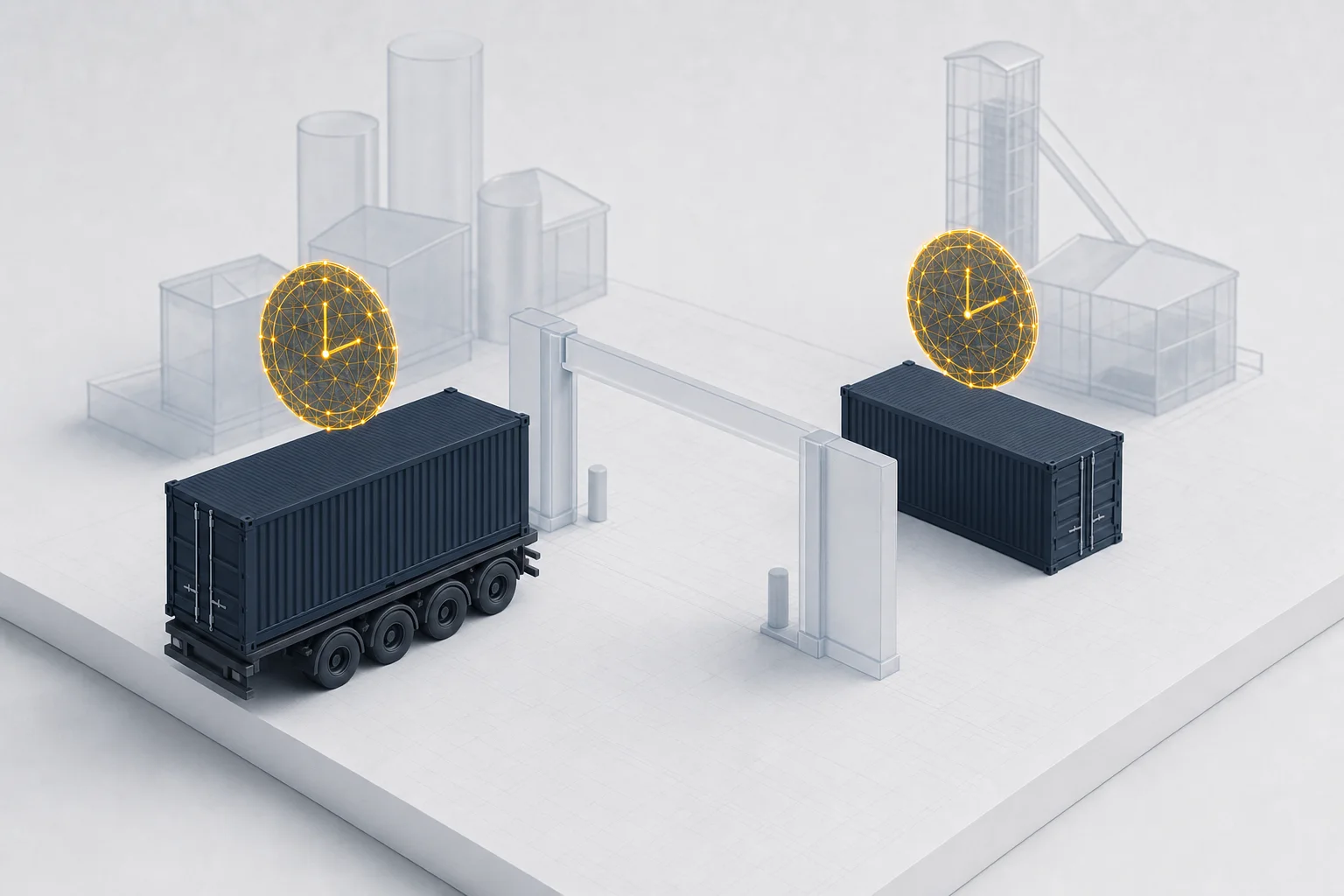
The short answer: demurrage is the charge for equipment sitting inside the carrier's facility past its free time; detention is the charge for equipment outside the facility, in your custody, past its free time. In ocean freight: a container still at the port accrues demurrage, a container out on your chassis accrues detention. In rail: a car held at your facility past free days accrues demurrage, and the same dwell-clock logic drives both. Different names, same underlying meter: someone else's equipment is waiting on you.
The one-sentence definitions
Demurrage is a per-day charge assessed when cargo or equipment stays inside a terminal, port, or rail-served facility beyond the allowed free time.
Detention is a per-day charge assessed when the carrier's equipment (a container, chassis, or trailer) stays out in your possession beyond the allowed free time. In trucking, "detention" also means the per-hour charge for keeping a driver waiting at your dock, which is a cousin of the same idea: the meter runs when you hold someone else's asset.
The confusion exists because both charges often appear on the same invoice, both are quoted per day, and both escalate the longer you wait. The location of the equipment is the whole distinction.
Side by side
| Demurrage | Detention | |
|---|---|---|
| Where the equipment is | Inside the terminal, port, or facility | Outside, in your custody |
| Ocean example | Container not yet picked up from the port | Container out on your chassis, not yet returned |
| Rail example | Railcar held at your facility past free days | Private-car storage and equipment-hold charges |
| Trucking example | Trailer occupying a yard or dock spot | Driver or trailer kept waiting at your dock |
| Typical free time | 2–7 days (ocean); 24–48 hours (rail) | 3–7 days for equipment; ~2 hours for drivers |
| Typical rates | Escalating tiers, often $75–$300+ per day | Often $50–$150+ per day per unit |
| The clock starts | At availability or placement (including constructive placement) | At pickup or release from the facility |
Rates and free time are set by each carrier's tariff or your contract, and ocean tariffs commonly escalate in tiers the longer equipment sits. Treat the numbers above as planning ranges, not quotes.
Rail's version: the dwell clock
At rail-served facilities the dominant charge is demurrage: cars placed (or constructively placed, meaning the railroad had the car ready but your facility couldn't take it) start a clock, free days run out, and every additional day bills per car. Class I tariffs commonly allow 24–48 hours and charge roughly $150–$200+ per car-day after that, with credit/debit systems on some roads that let early releases offset late ones.
The operational problem is that nobody sees the clock. Cars arrive Friday afternoon, the switch list doesn't get reconciled, a bay isn't empty when the car shows up, and the charge surfaces weeks later on the railroad's invoice as a line nobody can reconstruct. That's why the fix is visibility rather than negotiation: a per-car dwell clock that someone actually watches. Estimating your exposure takes thirty seconds with our free rail demurrage calculator; tracking it live per car is a core feature of Rebulk's railcar management software, which flags demurrage as it accrues instead of when it's invoiced.
How to reduce both charges
- Make the clocks visible. Most demurrage and detention isn't caused by capacity problems; it's caused by nobody knowing which clock is about to expire. A live dwell view per car or container beats any amount of after-the-fact dispute work.
- Work the free time, not the invoice. Free days are the cheapest capacity you have. Schedule unloading against the placement date, not against whenever the crew gets to it.
- Fix constructive placement traps. If the railroad regularly can't place cars because your tracks are full, the demurrage clock runs anyway. Track and spot visibility (knowing your real capacity before ordering cars in) prevents charges that never touched your dock.
- Dispute with records, not memory. Arrival, placement, release, and switch records win disputes. Facilities that keep per-car timelines recover charges that facilities running on spreadsheets simply pay.
FAQ
What is the difference between demurrage and detention? Demurrage is charged while equipment is inside the terminal or facility past free time; detention is charged while equipment is outside the facility in the customer's possession past free time. Same per-day logic, different location of the equipment.
Who charges demurrage and detention? Ocean carriers and ports charge them on containers, railroads charge demurrage on railcars under their tariffs, and trucking carriers charge detention for held trailers and waiting drivers. In every case the party that owns or operates the equipment bills the party holding it up.
How much is rail demurrage per day? Class I railroad tariffs commonly run roughly $150–$200+ per car per day after free time, which is typically 24–48 hours from placement or constructive placement. Exact rates and credit systems vary by railroad, so check the serving road's tariff.
Can Rebulk help reduce demurrage charges? Yes. Rebulk keeps a per-car dwell clock from placement to release, flags demurrage events as they accrue, and preserves the arrival, spot, and release records that win disputes, so charges get prevented or contested instead of discovered on the invoice.
Run your bulk terminal on one platform
Whether you need to measure inventory, track railcars, process paperwork, or bill customers, Rebulk gives your team one operating record that runs from the work performed to the invoice, set up around how you already work.