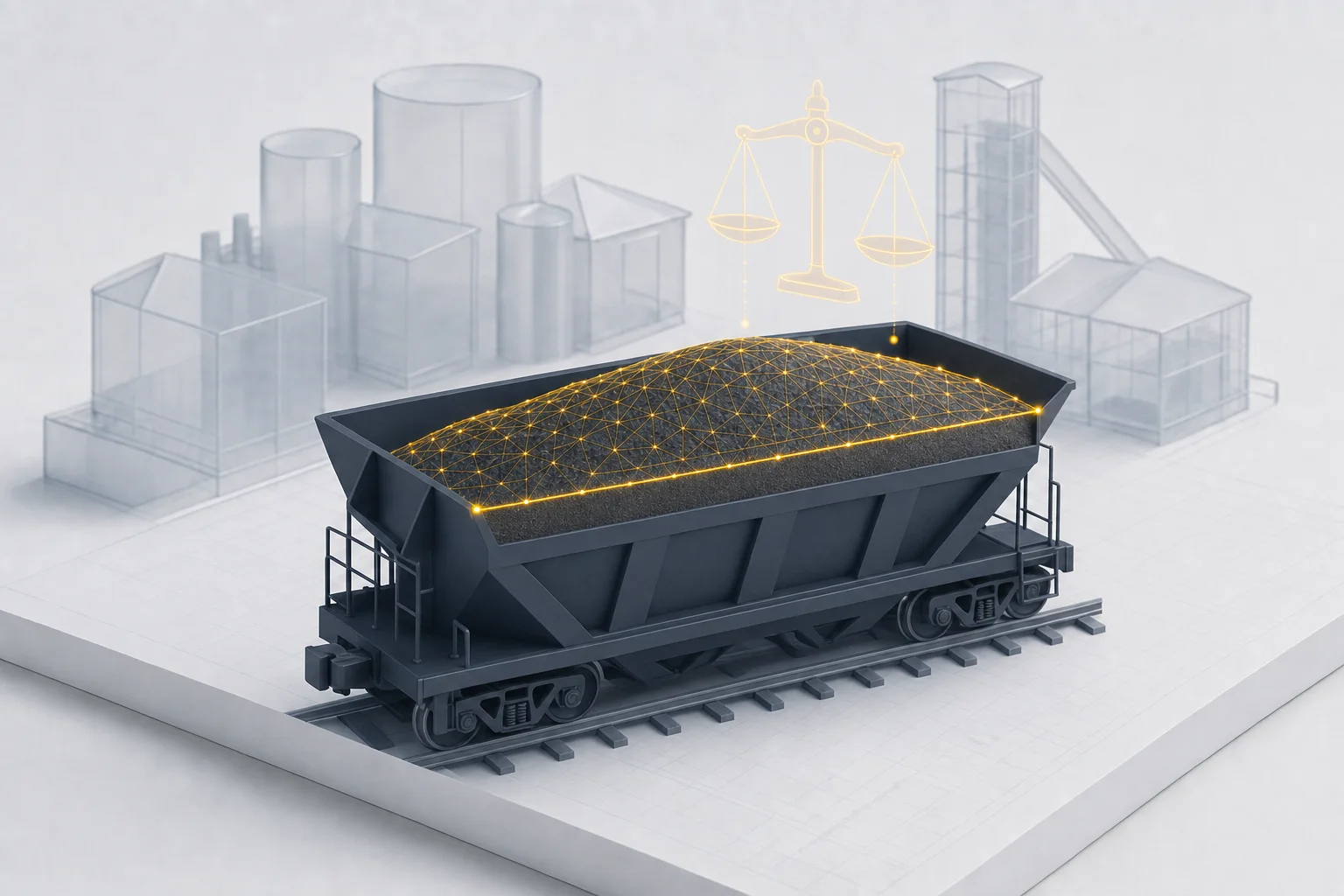
The short answer: every scale-based alternative (coupled-in-motion systems, portable wheel scales, a detour over someone else's certified scale) tells you a car's weight after it's loaded, when fixing an overload means digging material back out. The alternative that actually prevents overloads is measuring the load itself, live, while the car is filling: volume × material density = weight, updating in real time as material goes in, so loading stops at the limit instead of past it. No scale hardware, no set-outs, no giving back capacity by under-loading to be safe. That's what Rebulk's volumetric load measurement does, and it's the option this guide exists to explain, because when a shipper recently told us they'd searched for rail scale alternatives, they'd found almost nothing written about any of this.
Why overloads are expensive enough to plan around
Most interchange freight cars carry a gross rail load (GRL) limit of 286,000 pounds, with the car's specific load limit stenciled right on its side (some branch lines are still restricted to 263,000 lb). Release a car over that limit and the problems stack quickly: the railroad can set the car out, require re-weighing or partial unloading at your expense, assess overload charges under its tariff, and log the incident against your facility. An overloaded car is also a genuine safety issue on the mainline, which is why railroads treat it seriously rather than as a paperwork footnote.
The math that makes this a planning problem: a typical covered hopper tares around 30 tons, leaving roughly 100 tons of lading before the limit. Loading blind and aiming to "fill it up" leaves you guessing within a few percent of a line you're penalized for crossing. So facilities either under-load (paying for freight capacity they don't use, every car, forever) or occasionally overload (paying set-outs and charges). Both are real money.
Option 1: An in-ground static track scale
The gold standard. A certified static rail scale weighs each car precisely and produces billable, legal-for-trade weights. It's also a construction project: pit or pitless foundation, approach track, calibration, and certification, with installed costs that commonly run well into six figures before ongoing maintenance and re-certification. For a high-volume loadout shipping unit trains, it pays for itself. For a terminal releasing a handful of cars a day, it's the price of a locomotive for a measurement.
Choose it when: weights feed billing, volumes are high, and the capital is available.
Option 2: Coupled-in-motion (weigh-in-motion) systems
Weigh-in-motion rail scales weigh cars as they roll across instrumented rail at low speed, without uncoupling. Certified coupled-in-motion systems exist and cost meaningfully less than a full static scale, though they still involve track work, calibration, and site constraints (grade, speed, approach length).
Choose it when: you need per-car weights on every release but can't take the throughput hit of static weighing.
Option 3: Portable rail scales
Portable wheel-weighing pads placed under each truck can produce a car weight without permanent installation. They're the cheapest hardware route, but weighing a car means spotting it precisely on the pads, one car at a time, and accuracy is more sensitive to track condition and technique. Fine for periodic checks; slow as a per-release process.
Choose it when: you need occasional verification, not routine weighing.
Option 4: Someone else's scale
Some facilities route loaded cars over a nearby certified scale: the serving railroad's, or a neighboring shipper's. It works, but you learn the weight after the car has left, which converts an overload from a preventable mistake into an expensive surprise. Add switching charges and delay, and this is less an alternative than a fallback.
Choose it when: overloads are rare and you mostly need weights for records, not prevention.
Option 5: Measure the load while you're filling it (no scale at all)
Here's the option the scale vendors don't write about, and the one every method above is missing: weight is volume times density, both are measurable without a scale, and unlike a scale, volume can be measured while the car is still under the loadout.
How it works during loading: a sensor over the loadout (or a phone scan of the open car) reads the load's surface as material goes in. Rebulk computes the volume against the car's geometry and converts through your material's density, the number your scale tickets already give you, into a live weight estimate. The operator watches the fill climb toward the car's load limit and stops at the line, not past it. An overload never gets loaded, so it never has to be dug back out, re-weighed, or explained to the railroad.
The same live number fixes the quieter, more expensive habit too: under-loading to be safe. Cars released 5% under their limit are donating freight capacity on every shipment, forever. Topping off to the limit with a live measurement recovers it, car after car.
The honest caveat: a volumetric weight is an estimate, not a certified scale weight. Density varies with moisture and compaction, so this is a prevention and optimization tool, not a replacement for legal-for-trade weighing where billing demands it. Facilities that bill by weight still need a certified weight somewhere in the chain; the point is that the six-figure scale stops being the only defense against overloads.
Choose it when: the goal is preventing overloads at the loadout and maximizing fill, and certified weights either aren't required or already exist elsewhere in the chain. This is part of Rebulk's railcar management platform. Talk to us if you want to see it running on a loadout like yours.
The comparison
| Approach | Hardware cost | Certified weight | Catches overload before release | Throughput |
|---|---|---|---|---|
| Static track scale | Highest (six figures installed) | Yes | Yes, at weighing | Slow (spot each car) |
| Coupled-in-motion | High | Yes (certified systems) | Yes, at weighing | Good |
| Portable wheel scales | Low-mid | Varies | Yes, but slow | Poor |
| Off-site / partner scale | None | Yes | No (after departure) | Poor |
| Volumetric load measurement (Rebulk) | Low (sensor or phone) | No (planning estimate) | Yes: live, during loading | Excellent |
FAQ
How much does a rail scale cost? Installed static track scales commonly run well into six figures once the foundation, approach track, calibration, and certification are counted, with ongoing maintenance and periodic re-certification after that. Coupled-in-motion systems and portable wheel scales cost less, with trade-offs in throughput and certification.
How much does a railcar weigh? A typical empty covered hopper tares around 60,000–65,000 lb (about 30 tons). Loaded, most interchange cars are limited to 286,000 lb gross rail load, so a typical car carries roughly 100 tons of lading. The exact load limit is stenciled on each car.
What happens if a railcar is overloaded? The railroad can set the car out, require re-weighing or partial unloading at the shipper's expense, and assess overload charges under its tariff. Repeat overloads damage the relationship with your serving railroad, and an overloaded car is a legitimate safety concern on the mainline.
Can you estimate a railcar's weight without a scale? Yes: measure the volume of material in the car and multiply by the material's density. That's what Rebulk's volumetric load measurement does, live during loading, so cars can be topped off to their limit without crossing it. It produces a planning estimate rather than a certified weight, which is exactly what overload prevention needs. Talk to us if you load railcars and want to see it on your loadout.
Run your bulk terminal on one platform
Whether you need to measure inventory, track railcars, process paperwork, or bill customers, Rebulk gives your team one operating record that runs from the work performed to the invoice, set up around how you already work.