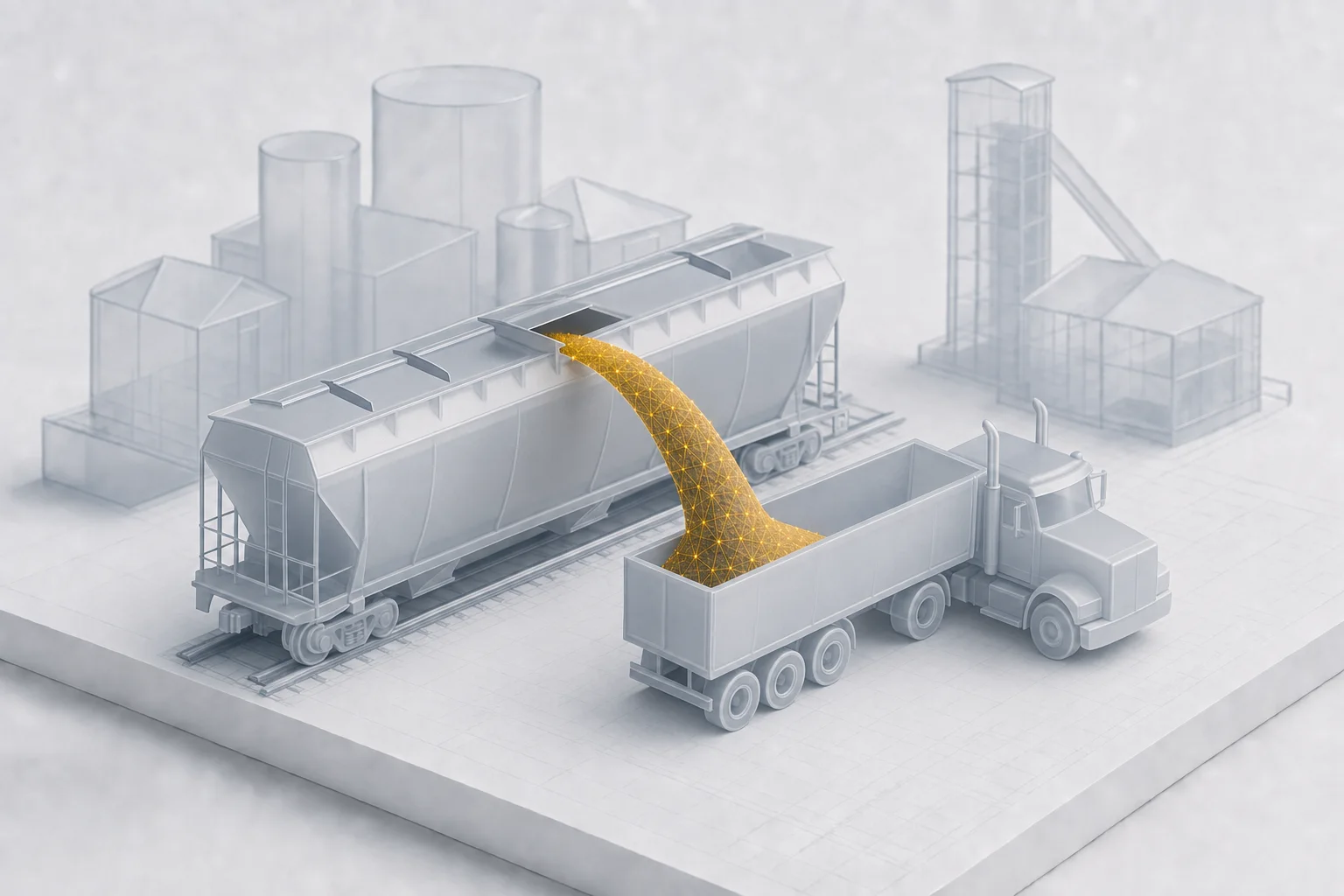
The short answer: a transloading service moves your freight between modes, usually rail to truck, at a terminal you don't own. You pay a per-ton or per-railcar handling rate, plus storage once free time expires. The right provider is decided by three things: the railroad serving the terminal, whether the terminal handles your commodity, and how far it sits from your customer. Rebulk publishes a free directory of 2,299 US transload facilities so you can filter on exactly those.
If you need the underlying concept first, what is transloading covers the definition and the step-by-step flow. This guide is about the commercial question: which company should do it, and what you're signing up for.
What a transloading service actually sells you
A transload company sells access to three things you'd otherwise have to build: a rail spur, the equipment to move material between a railcar and a truck, and the labor to run it. That is genuinely expensive infrastructure. A rail-served site with a spur, a loadout, and storage is a capital project measured in years, which is why most shippers rent it by the ton instead.
The economics that make it worth renting: rail is cheap over distance and truck is flexible at the end. Moving product most of the way by rail and trucking only the last leg from a terminal near your customer beats trucking the whole lane, as long as the handoff in the middle doesn't eat the savings. Everything below is about not letting it.
The five kinds of transloading service
These get quoted very differently, and the word "transloading" covers all of them.
1. Public (open-access) bulk transload
The most common arrangement. An independent terminal takes railcars from any shipper, unloads to truck, and bills per ton or per car. No commitment beyond the cars you send.
Choose it when: volumes are moderate or seasonal, you're testing a new lane, or you want to avoid a term contract. This is what most of the directory is made of.
2. Dedicated or contract transload
The terminal reserves track space, storage, and sometimes equipment specifically for you, under a term agreement with committed volume. Rates per ton drop; flexibility drops with them.
Choose it when: you're moving steady volume on a lane you'll still be running in two years, and you need guaranteed capacity at peak rather than whatever's free that week.
3. Third-party-managed transload
A 3PL contracts the terminals and sells you a managed service: they arrange the rail, the transload, and the drayage, and hand you one invoice. You get coordination and a single throat to choke, at a margin on top of the underlying handling rate.
Choose it when: you don't have the staff to manage railcars, terminals, and truckers as separate relationships, and you'd rather buy the coordination than build it.
4. Liquid and tank transload
Liquid bulk is its own discipline: pumps, hoses, containment, heated lines for viscous product, tank cleanliness, and hazmat handling where applicable. Terminals equipped for it are a distinct and much smaller population than dry bulk. In the directory, 978 facilities handle liquid bulk against 1,210 for dry bulk.
Choose it when: the product is liquid, obviously, but note that this is where "does the terminal handle my commodity" stops being a formality. Prior product in a tank car matters.
5. Port and marine transload
At a port, transloading usually means moving between vessel, rail, and truck, often with a warehouse in between. Volumes are larger, the scheduling is dictated by vessel windows, and demurrage exposure is higher on both the marine and rail sides.
Choose it when: the freight is arriving or departing by water and the inland leg needs to change modes anyway.
What you're actually paying for
Transload pricing is quoted in pieces, and comparing two quotes means lining up the pieces, not the headline rate. Rates vary widely by region, commodity, and volume, so treat this as the structure to ask about rather than a price list:
- Handling rate. Per ton or per railcar, for the physical transfer. The headline number.
- Minimum volume. Many terminals price against a monthly or annual commitment. Missing it can reprice everything else.
- Free time, then storage. Product sitting in the terminal is free for an agreed window, then billed by the day or the ton.
- Railcar demurrage. Charged by the railroad, not the terminal, once a car sits beyond its free time. This is the line that surprises people. Our demurrage calculator and demurrage vs detention explain how it accrues.
- Accessorials. Switching, car cleaning, tarping, sampling, extra labor, weekend work. Individually small, collectively not.
The structural point: the handling rate is the part you negotiate, and demurrage plus storage is the part that actually decides whether the lane was cheap. A terminal with a slightly higher per-ton rate that turns cars in two days beats a cheaper one that turns them in six.
How to choose: the three filters that matter
The serving railroad. This is the first filter, and it's close to binary. If your product moves on BNSF and the terminal is served by CSX, you're paying for an interchange, adding transit days, and adding a handoff where cars get lost. Match the terminal to the railroad that already serves your origin. The directory is filterable by serving railroad for this reason.
Commodity capability. "Bulk" is not one thing. A terminal set up for aggregates has the wrong equipment for plastics pellets, and a food-grade or hazmat commodity narrows the list sharply. Ask what else moves through the same equipment.
Distance to the final customer. The whole point is trucking a short last leg. Every mile between the terminal and the delivery point comes off the rail savings, and drayage is priced per mile in a way rail is not. In practice shippers work within a normal truck radius of the terminal, which is why our directory groups facilities into 85 metro areas on a 75-mile drayage radius rather than by city limits.
After those three, capacity and storage decide the shortlist: track space for the cars you'll send at peak, and covered or silo storage if your product can't sit outside.
| Public transload | Dedicated / contract | 3PL-managed | |
|---|---|---|---|
| Commitment | None beyond the cars sent | Term agreement, volume commitment | Contract with the 3PL |
| Rate per ton | Highest | Lowest | Underlying rate plus margin |
| Capacity at peak | Whatever is available | Reserved | Depends on their network |
| Who coordinates | You | You | They do |
| Best for | Seasonal, new lanes, testing | Steady multi-year volume | Small teams without rail staff |
| Where it breaks | No guaranteed space when busy | Paying for unused commitment | Least visibility into the terminal |
How to find transloading companies near you
Most of the searchable lists in this industry sit behind a signup wall, which is a strange thing to do to a directory. Rebulk publishes ours free, with a direct link to each facility rather than a lead form:
- The full US transload facility directory covers 2,299 named facilities across 49 states, compiled from the railroads' own public network directories and independently verified.
- By metro, on a 75-mile drayage radius: Houston, Chicago, and 83 others.
- By commodity, including dry bulk (1,210 facilities), liquid bulk (978), agriculture (814), metals (663), and aggregates (527).
- By serving railroad, across BNSF, NS, CSX, UP, CPKC, CN, and the shortlines.
If you're choosing between candidate sites rather than existing terminals, the rail transload planner routes a lane and estimates transit and cost across the actual rail network.
The part that breaks after you've picked one
Choosing a good terminal solves the physical problem. The one that shows up three months later is informational: nobody can say what's on the ground right now.
A transload terminal holds someone else's inventory, in piles and silos, across products and owners, while railcars accrue demurrage and trucks pull from the same stockpiles. The counts live in a mix of scale tickets, bills of lading, and a spreadsheet someone updates on Fridays. That's how a terminal ends up billing from last week's numbers, and how a shipper ends up unable to answer how much of their product is sitting at a terminal three states away.
This is the problem Rebulk builds for. The Transload Operating System puts inbound rail, capture, inventory, and billing on one record, so a railcar arriving, a pile being measured, and a truck being loaded are the same event rather than three systems reconciled later. Railcar tracking covers the demurrage clock side.
The honest caveat: if you move a handful of cars a year through one terminal, a spreadsheet is genuinely fine, and we'll say so. The math changes when there are multiple products, multiple owners, and a demurrage clock running on cars you can't see.
Frequently asked questions
What is a transloading service?
A transloading service transfers freight between transport modes at a terminal, most commonly from railcar to truck for bulk materials. Transload companies charge a handling rate per ton or per railcar, plus storage after an agreed period of free time. Rebulk publishes a free directory of 2,299 US transload facilities filterable by railroad, commodity, and metro area.
How much do transloading services cost?
Transloading is quoted as a handling rate per ton or per railcar, often against a minimum monthly volume, with storage charges after free time expires. Railroad demurrage on the cars is billed separately by the railroad. Rates vary by region, commodity, and volume, so comparable quotes require lining up handling, storage, demurrage exposure, and accessorials rather than the headline rate alone.
How do shippers choose a transload company?
Shippers filter first on the railroad serving the terminal, because a mismatch adds an interchange and transit days. Commodity capability comes second, since equipment for aggregates differs from equipment for plastics or liquid bulk. Distance from the terminal to the final customer comes third, because drayage miles come directly out of the rail savings.
What is the difference between public and dedicated transloading?
Public transload terminals accept railcars from any shipper and bill per ton or per car with no term commitment. Dedicated transload reserves track space, storage, and sometimes equipment under a term agreement with committed volume, which lowers the per-ton rate and guarantees capacity at peak in exchange for less flexibility.
Can Rebulk help a transload terminal manage inventory and billing?
Yes. The Rebulk Transload Operating System records inbound railcars, material capture, inventory by product and owner, and outbound loads on a single record, so billable events land as they happen rather than being reconciled from scale tickets and spreadsheets afterward.
Run your bulk terminal on one platform
Whether you need to measure inventory, track railcars, process paperwork, or bill customers, Rebulk gives your team one operating record that runs from the work performed to the invoice, set up around how you already work.
Related
All postsUS Transload Facility Directory
2,299 named transload facilities across 49 states, filterable by railroad, commodity, and metro
ProductTransload Operating System
Run a transload terminal on one record from inbound rail to outbound billing
GuideWhat Is Transloading?
The definition, the step-by-step flow, and why the paperwork gets complex