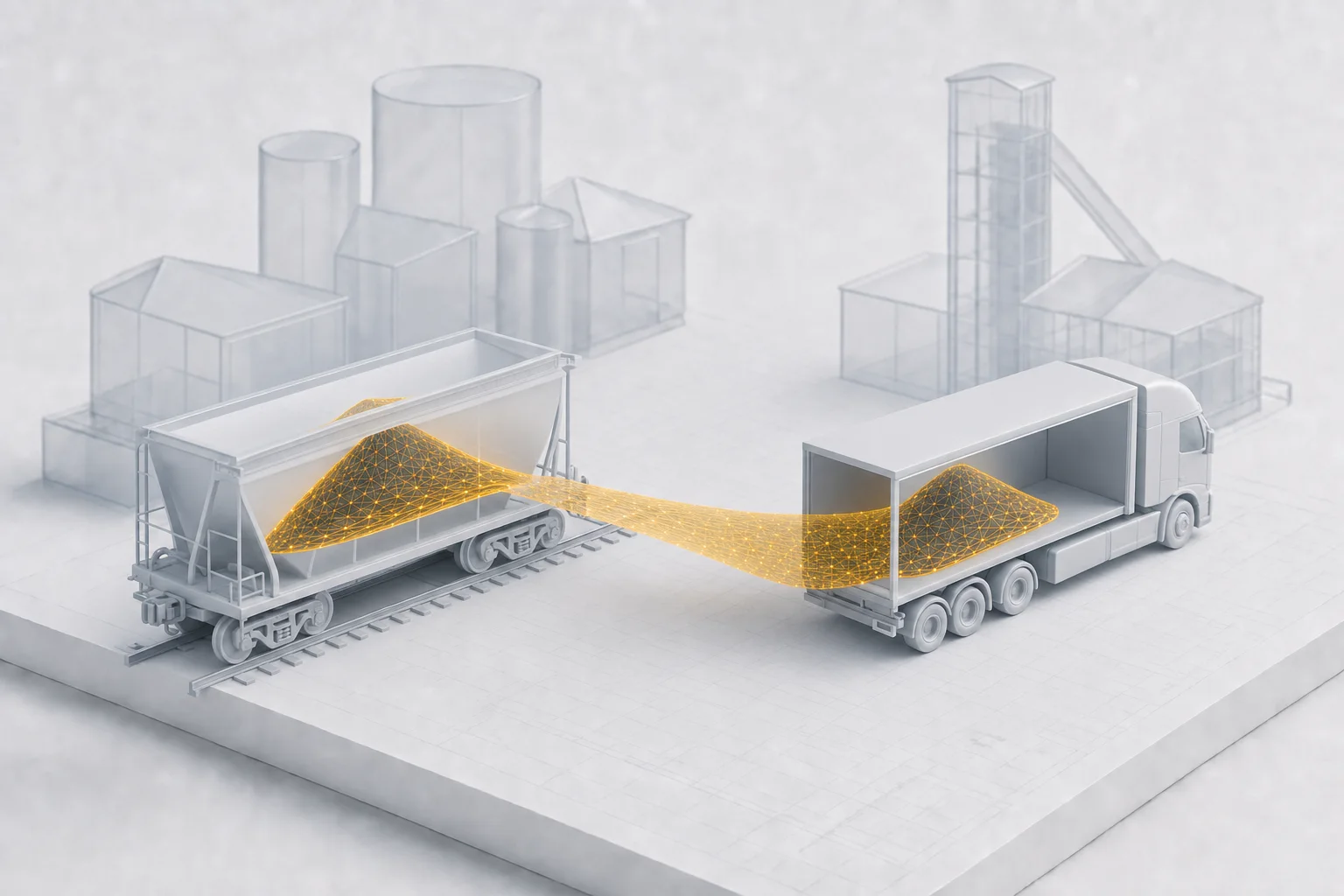
The short answer: Cross-docking is a logistics technique that moves goods straight from inbound vehicles to outbound vehicles at a facility, with little or no storage in between. Freight is unloaded from an arriving truck or railcar and transferred to a departing one, often within hours, to cut storage cost and speed delivery.
The one-line definition
Cross-docking gets its name from what physically happens: goods cross the docks, moving from a receiving door on one side of a building to a shipping door on the other, without being put away in between. A cross-dock facility is often a long, narrow building with inbound doors on one wall and outbound doors on the opposite wall, built so freight can flow across rather than sit. The working threshold most operators use is under 24 hours in the building, and often much less.
That single trait, almost no storage, is what separates cross-docking from ordinary warehousing. A warehouse exists to hold inventory: it receives goods, stores them for days or months, and picks them when an order comes. Cross-docking removes the store, put-away, and pick steps in the middle and keeps the freight moving.
The types of cross-docking
Cross-docking is usually described along two lines: when the outbound destination is decided, and how the freight is handled at the dock.
- Pre-distribution cross-docking. The outbound destination is known before the goods arrive, against firm orders. Staging is minimal and the flow is fastest.
- Post-distribution cross-docking. Goods are held briefly so the allocation can follow the latest demand rather than an older forecast, trading a little speed for flexibility.
- Continuous cross-docking. Inbound moves directly to outbound with the shortest possible dwell, the pure flow-through case for high-demand items.
- Consolidation. Several smaller inbound shipments are combined into one larger outbound load to cut per-unit freight cost, the classic less-than-truckload play.
- Deconsolidation. One large inbound load is broken into smaller outbound shipments for individual destinations, such as an import container split across many stores.
Retail made cross-docking famous, with grocery, perishables, apparel, and parcel networks built around it. The same technique runs at bulk and rail-served terminals, where a railcar of grain, aggregate, or fertilizer is unloaded straight into outbound trucks for regional delivery instead of into a silo or a pile.
Cross-docking vs warehousing vs transloading
The terms overlap, and the honest distinction is about two questions: does the freight get stored, and does it change transport mode?
| Cross-docking | Warehousing | Transloading | |
|---|---|---|---|
| Defined by | Little or no storage | Storing goods as a buffer | Changing transport mode |
| Dwell time | Hours, sometimes minutes | Days to months | Varies, often staged or stored |
| Mode change | Not necessarily | No | Yes, rail to truck by definition |
| Typical cargo | Palletized goods, perishables, bulk flow-through | Anything held as inventory | Bulk and break-bulk commodities |
The pairing that causes the most confusion is cross-docking and transloading. They answer different questions. Transloading is defined by a change of mode, moving freight from rail to truck or truck to rail. Cross-docking is defined by the absence of storage. A rail-to-truck move done straight through, with no dwell, is genuinely both at once, which is why terminals often chain them: transload inbound for the long-haul rail economics, cross-dock outbound for the speed. The difference is only which trait you are naming.
The benefits, and the tradeoffs
Cross-docking is popular because the savings are real, but the model is demanding, and it is worth being honest about both sides.
On the benefit side, cutting storage out of the middle removes warehouse space, rent, and the labor of putting away and picking. Freight reaches the shelf faster, which makes same-day and next-day delivery possible. Fewer touches and less dwell mean less damage and less spoilage, which matters for perishables. And consolidation trims freight cost by filling outbound loads.
The tradeoffs come from the same place. With little or no buffer stock, timing is everything: one late inbound truck cascades into a missed outbound, and a forecast miss becomes a stockout with no backup on the shelf. Cross-docking needs enough dock doors and enough carrier capacity to keep freight flowing, and it needs real-time inventory visibility, because product that never sits still is hard to see. That last point is the one that bites hardest in bulk.
The hardest thing to see is the thing that never stops
Every guide to cross-docking lists the same structural weakness: goods move so fast that they get tracked less closely than stored inventory. In packaged freight that is a nuisance. In bulk it is a real exposure.
You cannot cycle-count a pile that is already on the outbound truck. When a railcar of product is unloaded straight into trucks with no yard storage, the billable facts, which car it came from, what material it was, the net weight, the bill of lading and scale ticket, exist only in the minutes it crosses the dock. If material, weight, and documents are not captured on one record at the moment of the move, there is nothing to reconstruct from later, because the product never dwelled long enough to be counted.
This is the visibility layer that the flow-through model structurally lacks, and it is what the Transload Operating System is built to provide. Each inbound car is tied to its material, its measured weight and volume, and its documents on a single record as it moves, so a cross-docked load that never touched the ground is still fully accounted for when the invoice goes out. Cross-docking removes the storage. Keeping one record removes the tradeoff that came with it.
Frequently asked questions
What is cross-docking in logistics?
Cross-docking is a distribution technique in which inbound goods are unloaded and moved directly to outbound vehicles with little or no storage in between. Freight crosses from the receiving dock to the shipping dock, often within hours, which cuts storage cost and speeds delivery. Cross-docking suits high-volume, fast-moving freight where holding inventory adds cost without adding value.
What is an example of cross-docking?
A shipment of pallets arrives at a facility and, within a day, is split across three outbound trucks bound for different regions without ever being shelved or unpacked. The freight was there only long enough to change trucks. In bulk, the equivalent is a railcar of grain unloaded straight into outbound trucks for local delivery, with no silo storage in between.
What is the difference between cross-docking and warehousing?
Warehousing stores product for days to months and adds picking and other handling; cross-docking skips storage and moves goods straight through, usually in under a day. A warehouse is built to hold inventory as a buffer, while a cross-dock is built to keep freight flowing from the inbound door to the outbound door.
Is cross-docking the same as transloading?
No, though the two overlap. Transloading is defined by a change of transport mode, such as rail to truck. Cross-docking is defined by minimal or no storage. A rail-to-truck move done straight through is both at once, but transloading usually allows for staging or storage, while cross-docking aims to eliminate it.
What are the main benefits and drawbacks of cross-docking?
The benefits are lower storage and labor cost, faster delivery, and less spoilage from fewer touches. The drawbacks are that cross-docking demands tight scheduling, enough dock capacity, reliable inbound timing, and real-time inventory visibility. A single late truck or a forecast miss can break the flow, so cross-docking rewards operations that can see and coordinate freight in real time.
Run your bulk terminal on one platform
Whether you need to measure inventory, track railcars, process paperwork, or bill customers, Rebulk gives your team one operating record that runs from the work performed to the invoice, set up around how you already work.
Related
All postsWhat Is Transloading?
The related move that changes transport mode, and how it differs from cross-docking
ProductTransload Operating System
Keep material, weight, and documents on one record even when product never stops
ProductBulk Inventory System
Measured inventory for product that moves too fast to count