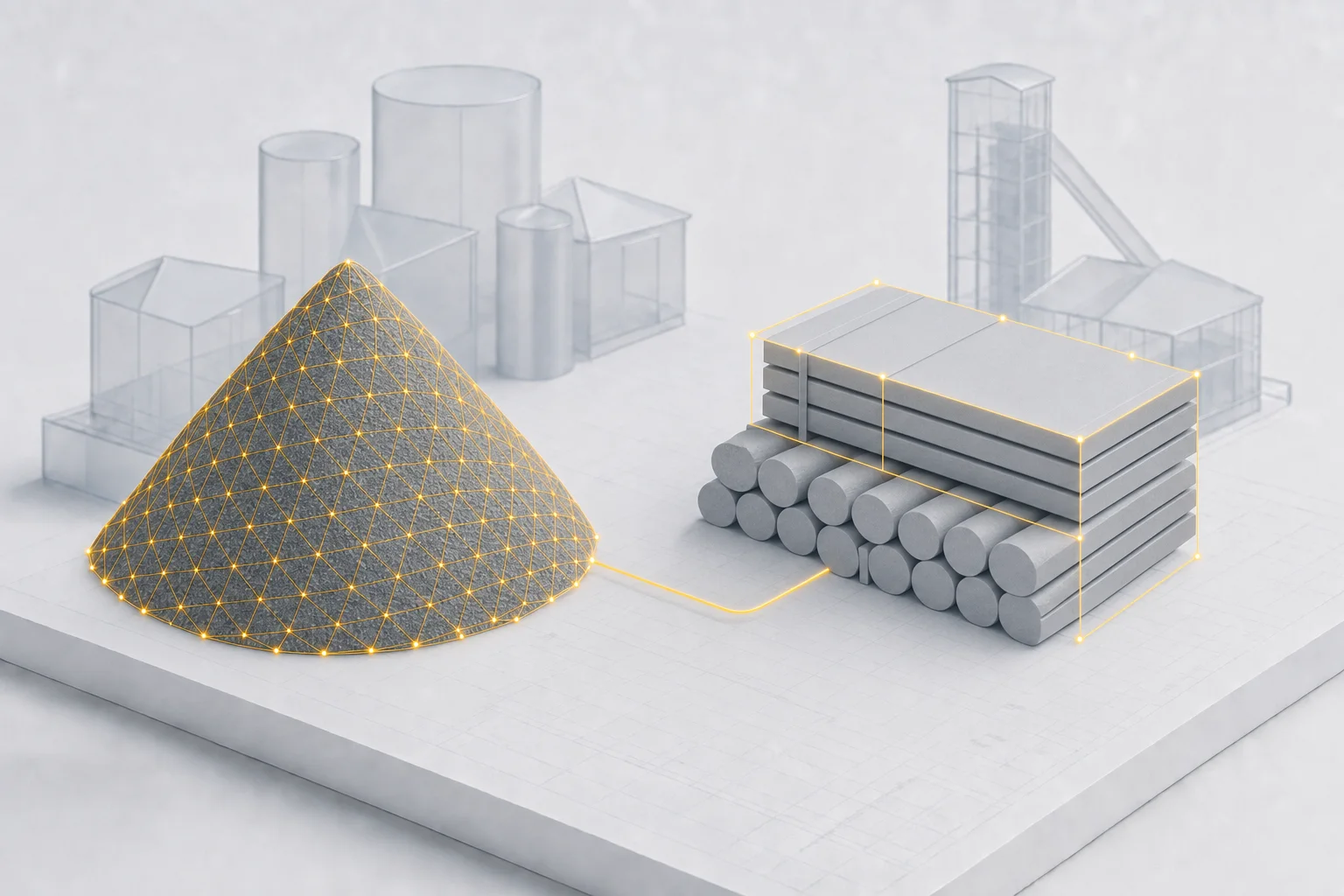
The short answer: Bulk cargo is loose material handled in mass (grain, aggregate, fertilizer, wood chips) and measured by volume or weight. Break bulk cargo is goods handled as individual units (bagged, palletized, drummed, crated, or project cargo) and tracked by count. Plenty of terminals handle both. Rebulk keeps inventory for both in one system: measured for the bulk piles, counted for the break bulk.
The one-line definitions
Bulk cargo is a commodity moved and stored loose, in mass, with no individual packaging: grain in a silo, aggregate in a bay, fertilizer in a pile, wood chips in a yard. You do not count bulk. You measure it, by volume or by weight.
Break bulk cargo is goods moved and stored as separate, countable units that are loaded and handled one piece at a time: bagged cement, palletized product, drums, steel coils, lumber bundles, machinery, and project cargo. You do not measure break bulk against a density. You count it, unit by unit.
The term "break bulk" comes from ocean freight, where it describes cargo loaded piece by piece onto a vessel rather than poured in as bulk or stacked in containers. On the ground at a terminal or a rail-served warehouse, the same split shows up every day: some of what moves through is loose and measured, and some of it is packaged and counted.
Side by side
| Bulk cargo | Break bulk cargo | |
|---|---|---|
| How it moves | Loose, in mass, poured or conveyed | As individual units, handled one at a time |
| Packaging | None | Bagged, palletized, drummed, crated, bundled |
| Examples | Grain, aggregate, fertilizer, coal, wood chips | Bagged product, steel coils, lumber, drums, machinery |
| How you learn the quantity | Measure it: volume or weight | Count it: units, pallets, pieces |
| Where it sits | Silos, bays, domes, open piles, hoppers | Racks, floor stacks, laydown yards |
| How Rebulk tracks it | Measured inventory per pile or bay | Counted inventory per unit or lot |
The distinction is not academic. It decides how you take inventory. A pile of fertilizer and a stack of palletized fertilizer are the same product, but one is a measurement problem and the other is a counting problem.
The line is about handling, not the commodity
Here is the part that trips people up: the same material can be bulk or break bulk depending on how the site handles it. Logs are the clearest example. A sorted timber load, scaled and moved piece by piece, is break bulk. The same logs heaped in a biomass yard and pushed around in mass by a loader get measured by volume, exactly like any bulk pile. Nothing about the log changed. The handling did.
That is exactly how we track the irregular log and forestry-residue piles in Charm Industrial's biomass inventory: far too many pieces to count by hand, so we measure the pile and convert to tonnage. Classify by how material moves through your site, not by what it is on a commodity list, and the right way to take inventory falls out on its own.
Why one terminal has both
Transload terminals, rail-served warehouses, and plants rarely deal in only one kind. A single site might unload bulk grain from a hopper car into a bay, receive palletized bagged product on the next track, and stage steel or lumber in a laydown yard. Break bulk and bulk share the same gate, the same yard, and often the same customer.
That mix is exactly where inventory gets messy. The bulk usually lives in one system (or on a whiteboard, or in a surveyor's spreadsheet), and the packaged goods live in another (or on a clipboard). The site ends up with two counts, two systems, and no single answer to "what do we have on hand right now."
Measuring bulk vs counting break bulk
Bulk is a measurement problem. You cannot count a pile, so you measure its shape, convert to volume, then to tonnage by density. That is what our Bulk Inventory System does: fixed sensors, a phone scan, or a drone flight reads the surface of a pile, bay, or railcar and turns it into a measured quantity. No pacing off the base, no eyeballing the height. (If you want the density step by hand, our cubic yards to tons converter handles it.)
Break bulk is a counting problem. A pallet of bagged product either arrived or it did not, and the number that matters is the count, tied to the bill of lading, the customer, and the lot. There is nothing to measure. There is something to track: received, staged, loaded, shipped.
Both are inventory. Both need to roll up to one number that operations manages, accounting closes on, and customers get billed from. The mistake is treating them as two separate worlds because they happen to be counted two different ways.
One record for both
This is where a terminal running two systems pays for it twice. Rebulk keeps bulk and break bulk on one inventory record. The bulk piles are measured and continuously updated, the break bulk units are counted and tracked as they move, and the same paperwork ties both together. Inbound bills of lading, waybills, and scale tickets come in the same way for a hopper car of loose material and a flatcar of banded lumber. Rebulk captures each document once and attaches it to the right record, along with the customer and the railcar or truck it arrived on. When someone asks what is on the ground for a given customer, the answer covers the measured tons of loose material and the counted units of packaged goods, with the documents behind both, in one place.
That paperwork intake is the core of the Transload Operating System: a site that takes in bulk and break bulk, off rail and off truck, pulls the BOLs and waybills in as they arrive, and keeps one operating record instead of a pile count in one tool, a unit count in another, and a stack of paper in between. Measured for what you measure, counted for what you count, documented the same way for both, and reconciled to a single source of truth.
Frequently asked questions
What is the difference between bulk and break bulk cargo?
Bulk cargo is loose material handled in mass with no packaging (grain, aggregate, fertilizer) and is measured by volume or weight. Break bulk cargo is goods handled as individual, countable units (bagged, palletized, drummed, or crated) and is tracked by count. The practical difference is how you take inventory: you measure bulk and you count break bulk.
Is break bulk the same as general cargo?
They overlap. "General cargo" usually means any non-bulk goods, and break bulk is general cargo handled piece by piece rather than in a container. In a terminal or warehouse, both refer to packaged, countable goods, as opposed to loose bulk material poured or conveyed in mass.
What is break bulk in a warehouse or terminal?
Break bulk in a warehouse or terminal is packaged, countable inventory: bagged product, palletized goods, drums, steel, lumber, or project cargo staged and handled as individual units. It contrasts with bulk material, which is stored loose in silos, bays, or piles and measured rather than counted.
Can one system track both bulk and break bulk inventory?
Yes. Rebulk tracks both on one record: bulk is measured per pile or bay using sensors, phone capture, or drone data, and break bulk is counted per unit or lot. Both tie to the same customer, railcar, and paperwork, so a terminal that handles both gets one inventory number instead of two disconnected counts.
Run your bulk terminal on one platform
Whether you need to measure inventory, track railcars, process paperwork, or bill customers, Rebulk gives your team one operating record that runs from the work performed to the invoice, set up around how you already work.